
When I first started traveling, I carried a quiet set of beliefs that I didn’t even realize weren’t mine.
Travel is expensive.
Travel is dangerous.
Travel is complicated.
Travel is “not for people like you.”
If you’re from the West — especially if you’re from a marginalized group, especially if you’re a woman — you’ve probably heard some version of that narrative too. It’s subtle. It’s constant. And it keeps a lot of people grounded in ways that have nothing to do with fear of flying.
So when I found myself in northern Thailand considering paragliding just outside Chiang Mai, I paused — not because I didn’t want to do it, but because I was confronting those old assumptions in real time.
Was it safe?
Was it expensive?
Was it irresponsible?
The answer turned out to be… none of the above.
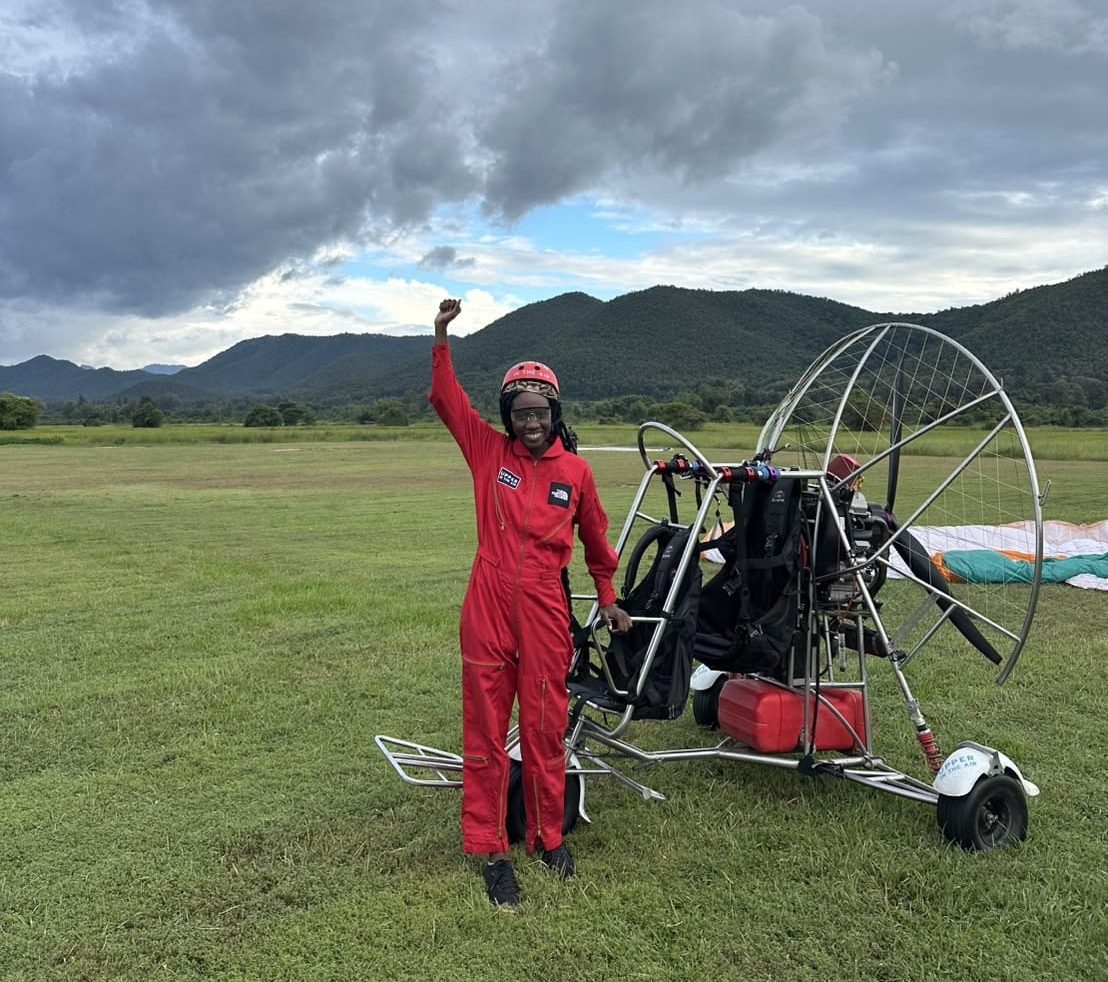
Tucked away in the open countryside — where wide fields stretch endlessly and the mountains frame the horizon — there’s a small paragliding school that delivers an experience that feels both effortless and unforgettable.
And surprisingly? It’s affordable. As a tourist, you can usually expect to pay around $60 USD (sometimes even less), which makes it one of those rare adrenaline experiences that doesn’t completely wreck your travel budget. An experience I had once mentally categorized as “extreme” and “luxury” was suddenly accessible.
That realization alone shifted something in me.
The Seamless Setup
What really impressed me was how smooth everything felt from start to finish.
The school arranged transportation, picking me up directly from my accommodation and driving me back afterward. No scrambling to find directions. No navigating unfamiliar highways. Just a simple message exchange and a confirmed pickup time.
They provided:
- Protective goggles
- A full paragliding suit
- A GoPro with a selfie stick so I could film the entire flight
- Photos taken before takeoff
They were thoughtful. Organized. Calm. The instructors moved with the kind of quiet confidence that makes your nervous system relax without you even noticing.
And that matters.
Because so many of us are taught that being adventurous means being reckless. But this experience felt intentional. Supported. Safe.
It challenged another quiet belief I’d carried: that doing something bold means doing it alone.
I wasn’t alone. I was guided.
That First Lift-Off
And then… you’re in the air.
There’s this surreal moment when your feet leave the ground. It’s not dramatic in the way movies make it seem. It’s softer. One second you’re running forward, and the next you’re floating.
The world below opens up in a way you’ve never seen before.
Looking down, everything felt miniature.
The trees looked like tiny Lego pieces snapped together into neat little patterns. The fields resembled patchwork quilts. The cows and horses grazing below were so small that at first I genuinely wondered if they were dogs.
It felt like looking into a dollhouse version of Earth.
And I remember thinking: This must be how God feels looking down at creation.
Not in an ego-driven way. But in an awe-filled way.
For the first time, I was seeing the world from a perspective that had always been inaccessible to me. And something about that literal shift in perspective created an internal one.
Up there, the world felt enormous.
And so did my life.
Perspective From Above
Paragliding wasn’t just an adrenaline activity — it was transformative.
From the sky, I could see just how expansive everything was. The land stretched beyond what I could fully process. Roads wound into the distance. The horizon seemed infinite.
It made my own fears feel smaller.
Many of us grow up in environments that feel limiting — socially, financially, emotionally. We’re often taught to shrink our desires to match our surroundings. To be practical. To stay safe. To stay close.
But hovering above the countryside outside Chiang Mai, I realized something very simple and very grounding:
The world is big.
Bigger than the stories we’re told about what’s possible.
Bigger than the narratives about who gets to explore it.
Bigger than the fears we inherit.
And I had navigated myself there.
I had booked the experience.
I had arranged the timing.
I had shown up.
I had trusted myself.
That did something for my sense of self.
Travel, especially solo travel, quietly builds evidence. Evidence that you can plan your life. Evidence that you can adapt. Evidence that you can place yourself in new environments and not only survive — but thrive.
While traveling, I found it easier to meet aligned people. Other travelers were open, curious, growth-oriented. Conversations felt expansive rather than familiar and fixed. It reminded me that the environments we choose shape who we believe we can be.
And once I saw that I could create that kind of experience for myself — independently, thoughtfully, affordably — I knew I could do it again.
Expansion Is Accessible
One of the most powerful parts of this experience was realizing how accessible it actually was.
It wasn’t a luxury reserved for influencers or thrill-seekers with unlimited budgets. It wasn’t chaotic or dangerous. It wasn’t financially irresponsible.
It was $60.
It was organized.
It was safe.
It was joyful.
And in a world where we now have access to social media, digital communities, and AI tools that can help us research, plan, and evaluate experiences in seconds, it has never been easier to design travel that fits your personality and your budget.
You don’t have to feel stuck.
You don’t have to wait for permission.
Sometimes expansion looks like therapy.
Sometimes it looks like journaling.
And sometimes… it looks like running off a hillside in Thailand and floating above fields that look like Legos.
I would do it again in a heartbeat.
But more importantly, I carry what it gave me.
Perspective.
Confidence.
Proof that the world is wider than I was taught.
And that I am fully capable of exploring it.